
Waste disposal principles
Radioactive waste is produced in Switzerland every day. It is generated during electricity production in the four nuclear power plants (NPPs), during the dismantling of the Mühleberg NPP, but also in medicine, industry and research. Due to their different radiological properties, radioactive waste is divided into high-level waste (HLW), low- and intermediate-level waste (L/ILW) and alpha-toxic waste (ATW). HLW comprises spent fuel from nuclear power plants and vitrified fission products from the reprocessing of spent fuel. The L/ILW mainly consists of operational, reactor and decommissioning waste from nuclear power plants and waste from the medical, industrial and research sectors. The ATAs comprise a rather small amount of waste whose radioactivity is characterised by a particularly high activity of alpha radiation.
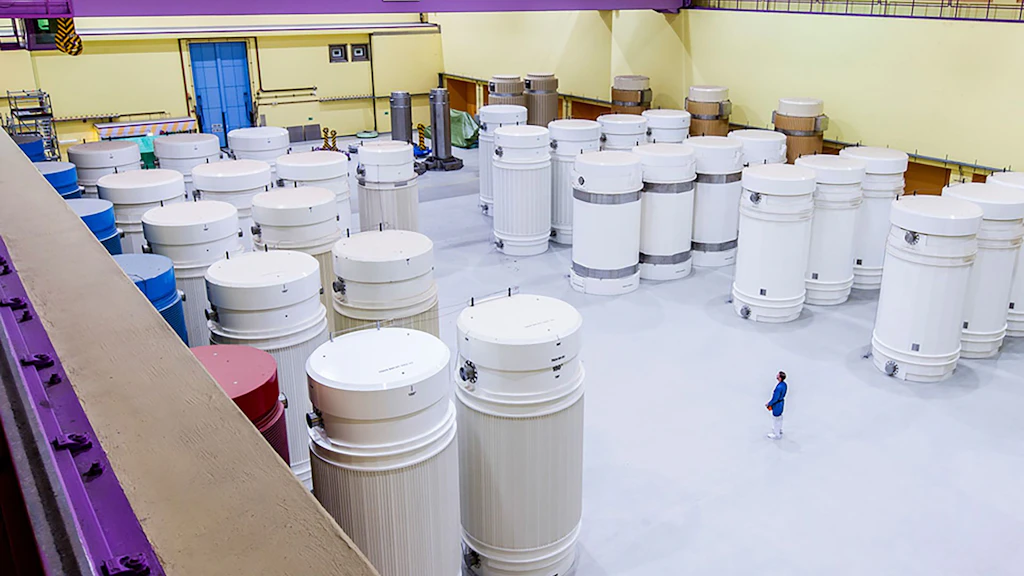
A volume of around 80,000 cubic metres of radioactive waste will be generated by 2075 (see table below). Around 90 per cent of this is L/ILW, most of which is generated when the nuclear power plants are dismantled. Depending on the category of waste, this radioactive waste must be stored safely for several tens of thousands to a million years until it no longer poses a risk to humans or the environment. At the moment, radioactive waste is stored in well-secured halls above ground. These halls are located at the nuclear power plants and in two centralised interim storage facilities in the canton of Aargau (see picture above: Zwilag).
Waste volumes and activities according to the Waste Management Programme 2021, Tab. 2.1-1, p. 13, Scenario 2b (60-year lifetime of the existing nuclear power plants, Mühleberg 47 years) and MIRAM-RBG (Nagra NTB 22-05, 2023) Tab. 7-4, p. 50.